
Starting strength training can feel complicated. One person recommends barbells, another swears by resistance bands, and a third insists every session should leave you exhausted. None of that is necessary when you are learning. Strength training for beginners works best when you practise a few useful movements, repeat them consistently and increase the challenge gradually.
Your first month’s goal is not to lift an impressive number. It is to learn how your body moves, find a manageable level of effort and build a routine you can return to.
Begin with movements, not machines
Resistance training means making your muscles work against a load. That load might be your bodyweight, a dumbbell, an elastic band or a gym machine. These resistance training basics matter more than the equipment you choose.
Organise a beginner strength workout around five movement patterns rather than memorising dozens of exercises.
Squat
Sitting down onto a sturdy chair and standing up again is a squat pattern. Keep your feet planted, move at a controlled pace and use a higher chair if depth feels difficult. This develops strength in the legs and hips.
Hinge
A hip hinge involves moving your hips backwards while keeping your back comfortably aligned. Practise reaching towards your knees before trying a light dumbbell deadlift. It teaches you to lift objects using your hips rather than rounding forwards.
Push and pull
A wall press-up or hands-on-bench press-up introduces pushing. A resistance-band row or supported dumbbell row introduces pulling. Together, these train the chest, shoulders, upper back and arms.
Brace and carry
Standing tall while holding a manageable weight at your side teaches trunk stability. Start with a short carry, keeping your shoulders level. A modified plank is another option.
Choose one accessible exercise for each pattern and keep it familiar long enough to improve your technique.
Choose equipment that makes repetition easy
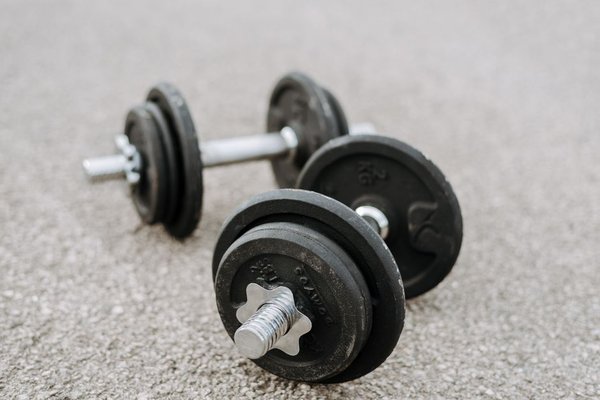
Weight training for beginners does not require a home gym. A stable chair, resistance band and perhaps one or two light dumbbells can cover plenty of ground. Gym machines can guide movement and allow small weight adjustments; free weights demand more coordination.
Someone in a small flat might use chair squats, incline press-ups and band rows. Someone at a leisure centre might choose the leg press, chest press and seated row. Neither approach is automatically superior.
If you are setting up at home, a guide to home strength exercises can help you adapt movements to limited space.
Understand sets, repetitions and effort
A repetition, or rep, is one complete movement. A set is a group of repetitions performed before resting. Eight chair squats followed by a break is one set of eight.
The NHS suggests aiming for eight to twelve repetitions per activity and building towards two or three sets. If you are completely new, one controlled set can be a reasonable starting point while establishing the habit. Increase gradually.
Your last few repetitions should feel challenging, but still controlled. A useful check is whether you could manage another two or three good repetitions before stopping. If you are holding your breath, rushing or losing your balance, reduce the resistance.
Rest roughly one to two minutes between sets, or longer if needed to recover for another controlled attempt. Technique matters more than speed.
A straightforward two-day strength routine
UK physical activity guidance recommends muscle-strengthening activity on at least two days each week, working major muscle groups. Two full-body sessions on non-consecutive days are practical. For example, choose Monday and Thursday rather than training the same muscles hard on consecutive days.
Session A
Warm up with several minutes of comfortable walking or marching, followed by gentle practice repetitions. Then perform chair squats, wall press-ups, resistance-band rows and a short, light carry. Start with one or two sets of eight to twelve controlled reps for the first three movements. Carry for twenty to thirty seconds with steady posture.
Session B
After a similar warm-up, practise a bodyweight hip hinge, supported split squat or low step-up, seated chest press or incline press-up, and another row variation. Use the same modest starting volume. Substitute exercises if you cannot control the movement comfortably.
Imagine finishing Session A and feeling you could have done more. That’s fine: your first workout is a rehearsal, not a test. Record your exercises and repetitions so the next session has a clear starting point.
Progress without chasing heavier weights
Progressive overload means making an exercise slightly more demanding as you adapt. First, complete your repetitions with consistent form. Next, add a repetition or two within your target range. When twelve reps feel controlled across your sets, consider a small increase in resistance and return towards eight reps.
Progress can also mean using a lower incline for press-ups, improving balance during a split squat or moving through a comfortable, fuller range. Change only one thing at a time so you can assess the effect.
A notebook or phone note is enough to track your strength routine. Record the exercise, resistance, sets, reps and a comment such as ‘steady’ or ‘last two difficult’. A guide to tracking workout progress can make those notes more useful.
Recover well and recognise warning signs
Muscles need time to adapt between challenging sessions. Regular sleep, adequate food and rest days support that process. Light walking is fine between workouts. Mild soreness can happen when an exercise is new, but soreness is not proof of success.
Sharp pain, unusual dizziness or persistent joint pain are reasons to stop and assess. If you have a significant medical condition, recent injury, pregnancy-related concerns or a history of falls, ask an appropriate healthcare professional about suitable modifications before starting.
Learning how to warm up before exercise also helps you avoid treating the first demanding repetition as a warm-up.
Frequently asked questions
How many days a week should beginners lift weights?
Two full-body sessions per week are a useful starting point and align with UK guidance to strengthen major muscle groups on at least two days. Add more later if recovery and scheduling allow.
Should I use dumbbells or resistance bands?
Either works. Choose resistance that lets you complete repetitions with control. Bands are portable; dumbbells make consistent weight increases straightforward.
How long before I notice results?
You may notice smoother movements and better coordination within the first few weeks. Visible muscle changes depend on training, sleep, nutrition and your starting point, so do not judge progress by photographs alone.
Can I combine strength training with walking or running?
Yes. Strength work complements aerobic activity rather than replacing it. UK guidance separately recommends regular moderate or vigorous aerobic exercise, so plan both sustainably.
Build a routine you can repeat
The strongest beginner plan is usually the one with the fewest barriers. Learn a handful of movement patterns, practise them twice weekly, allow recovery and make small changes when they become easier. Those early weeks build a foundation for more advanced training later.